The Joint FAO–WHO-WOAH Global Early Warning System for health threats and emerging risks at the human–animal–ecosystem interface (GLEWS+)
Advancing one health intelligence to anticipate emerging risks and guide decisions
Learn, Research, Discover
From official reports to interactive datasets, find everything you need to understand and study zoonotic outbreaks worldwide.
The 9th World One Health Congress in Lisbon
The global One Health Community organizes the 9th World One Health Congress in Lisbon 4-7 September 2026
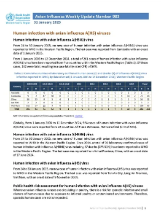
WHO Western Pacific: Avian Influenza Weekly Update # 1030: 23 January 2026
From 1 January 2003 to 19 December 2025, a total of 481 cases of human infection with avian influenza A(H5N1) virus have been reported from six countries within the Western Pacific Region.
Cumulative number of confirmed human cases for avian influenza A(H5N1) reported to WHO, 2003-2025, 19 December 2025
WHO publishes information on human cases with influenza A(H5N1) avian influenza infection on a monthly basis on the Influenza webpage
ASF report
Test
CAVEPM webinar
Canadian Association of Veterinary Epidemiology and Preventive Medicine (CAVEPM) Conference. Calgary - 2025
Informe sobre el Grupo de Expertos para la CIPCIZA - Vigilancia, Laboratorio y Evaluación de riesgos intersectorial
Expert group meeting report on surveillance, laboratory work, and risk evaluation.
Pre-donning and doffing of PPE by healthcare workers in the event of avian influenza
Steps for safe donning and doffing of PPE for healthcare workers in avian influenza.
Recommendations for the early detection of human cases of avian influenza A(H5N1).
Guidance for early detection of human cases of avian influenza A(H5N1).
Respiratory sample collection for zoonotic influenza diagnosis (Influenza A/H5 and other zoonotic influenza viruses).
Respiratory sample collection guidance for zoonotic influenza diagnosis.
Samples from patients suspected of Influenza A/H5 – Laboratory Testing Algorithm.
Laboratory testing algorithm for suspected influenza A/H5.
Epidemiological Update: Avian Influenza A(H5N1) in the Americas Region, 24 January 2025.
Update on H5N1 epidemiology in the Americas as of 24 January 2025.
Strengthening the intersectoral work for influenza at the human-animal interface in the Americas Region: technical questions and answers.
Technical Q&A on intersectoral work for influenza surveillance and response.
Tripartite Zoonoses Guide (TZG)
Guidance for countries to strengthen coordinated One Health management of zoonotic threats.
TZG Operational Tools (OTs)
Practical tools supporting national implementation of the Tripartite Zoonoses Guide.
Tripartite MOU
Tripartite technical guidance tools for coordinated One Health action.
Joint statements/reports
Shared Tripartite outputs on emerging health threats and coordinated response.
RVF DST Tool dashboard
Decision-support tool for assessing Rift Valley fever risk and scenarios.
Avian Influenza – Preparing Food Safely (infographic)
Simple guidance on preparing food safely to reduce avian influenza risk.
Five Keys for Safer Traditional Food Markets: Risk Mitigation in the Asia-Pacific Region (1)
Regional guidance promoting safer practices in traditional food markets.
Five Keys for Safer Traditional Food Markets (video) (1)
Short video on applying the five keys for safer traditional food markets.
WHO Rapid Risk Assessments
WHO assessments of emerging threats and their public health risks.
WHO Emergency Situation Reports
Country updates on emergencies, response actions, and health impacts.
WHO Global Influenza Programme (GIP)
Weekly influenza trends, virology data, and global surveillance.
PAHO Epidemiological alerts and updates
Strengthening global health security at the human-animal interface
Strengthening global health security through One Health collaboration at the human–animal interface.
WHO 2019 nCoV-fur-farming risk assessment
WHO assessment of COVID-19 risks linked to fur farming and animal–human transmission.
Practical interim guidance to reduce the risk of infection in people exposed to avian influenza viruses
Advice to reduce infection risk among people exposed to avian influenza.
Risk assessments and summaries of influenza at the human–animal interface
Monthly assessment of influenza threats at the animal–human interface.
Avian influenza A(H7N9) virus
Information on H7N9 virus characteristics, risks, and global epidemiology.
Avian influenza A(H5N1) virus
https://www.who.int/teams/global-influenza-programme/avian-influenza/avian-a-h5n1-virus
Global Influenza Programme
Latest confirmed outbreaks and key public health updates from WHO.
The Quadripartite Joint Offer-A call for targeted investment in One Health
Invitation to fund and strengthen One Health systems worldwide under OH JPA.
WAHIS support desk
Help and guidance for users managing data and reports in WAHIS.
WOAH OH policy briefs
Policy briefs guiding cross-sector One Health actions and strategies.
Wildlife health resources
Resources on wildlife disease, biodiversity & ecosystem health for One Health.
ICEID conference poster, 2022
International Conference on Emerging Infectious Diseases (ICEID) Conference. Atlanta - 2022
WOHC conference oral presentation, 2024
World One Health Congress (WOHC) Conference. Cape Town - 2024
CAVEPM conference poster, 2025
Canadian Association of Veterinary Epidemiology and Preventive Medicine (CAVEPM) Conference. Calgary - 2025
Tripartite Commitment 2017
Joint commitment by FAO, OIE, and WHO to strengthen One Health collaboration globally.
Tripartite Concept Note 2010
Foundational framework for FAO, OIE, and WHO collaboration on zoonotic disease risks.
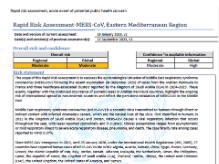
Rapid risk assessment: foot-and-mouth disease (FMD)
FMD serotype SAT 1 risk assessment
ASF situation in Asia & Pacific update
FAO issues regular disease situation updates on a number of key transboundary, epidemic, endemic and emerging diseases.
Emerging zoonotic coronaviruses in animals
https://www.fao.org/animal-health/situation-updates/emerging-zoonotic-coronaviruses-in-animals/en
Sub-Saharan Africa HPAI
FAO issues regular disease situation updates on a number of key transboundary, epidemic, endemic and emerging diseases.
Global AIV with Zoonotic Potential
FAO issues regular disease situation updates on a number of key transboundary, epidemic, endemic and emerging diseases.
FAO Risk Monitor platform
Early warning platform providing alerts on food and agriculture risks.
FAO’s EMPRES Global Animal Disease Information System (EMPRES-i+)
Global system tracking animal disease events, trends and risk signals.
HPAI dashboard
Platform tracking high pathogenicity avian influenza trends and outbreaks.
Rapid risk assessments
Joint rapid reviews to support timely evaluation of emerging threats.
Updated joint FAO/WHO/WOAH public health assessment of recent influenza A(H5) virus events in animals and people (Assessment based on data as of 1 March 2025)
Public health evaluation of H5 events using data available up to March 2025.
Updated joint FAO/WHO/WOAH public health assessment of recent influenza A(H5) virus events in animals and people (Assessment based on data as of 1 July 2025)
Tripartite assessment of recent H5 activity and associated public health risk.
Quadripartite One Health Intelligence Scoping Study
Scoping study on One Health intelligence needs across FAO, WHO, WOAH, and UNEP.
OH JPA
Foundational agreement defining FAO, WHO and WOAH collaboration.
Global strategy for the prevention and control of high pathogenicity avian influenza (2024–2033)
FAO–WOAH network providing global expertise on animal influenza viruses.
OFFLU
FAO programme supporting early warning, prevention and control of animal diseases.
Emergency Prevention System for Animal Health (EMPRES-AH)_WHO Secretariat
Early warning framework to detect and respond to emerging animal health threats.
Zoonosis
Overview of zoonoses priorities and activities in the Americas Region.
Pan American Center for Foot-and-Mouth Disease and Veterinary Public Health
Information on PANAFTOSA’s work in foot-and-mouth disease and veterinary public health.
Rabies
Overview of rabies as a zoonotic disease in the Americas.
Report of the Regional Consultation for the Strengthening of Intersectoral Work in the Human-Animal Interface of Influenza.
Report from regional consultation on strengthening intersectoral influenza work.
Prevention and Control of Healthcare-Associated Infections.
Guidance on preventing and controlling healthcare-associated infections.
Epidemiological Update: Avian Influenza A(H5N1) in the Americas Region, 24 January 2025
Update on H5N1 epidemiology in the Americas as of 24 January 2025.
Informe sobre el Grupo de Expertos para la CIPCIZA - Reunión de grupos de trabajo: Vigilancia, Laboratorio y Evaluación de riesgos intersectorial
Expert report on intersectoral surveillance, lab work, and risk assessment.
Call to action to establish the Intersectoral Commission for the Prevention and Control of Zoonotic Influenza in the Americas.
Call for establishing an intersectoral commission for zoonotic influenza control.
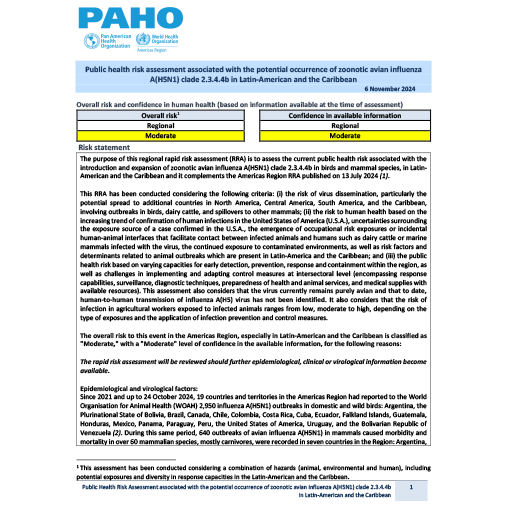
Public health risk assessment associated with the potential occurrence of zoonotic avian influenza A(H5N1) clade 2.3.4.4b in Latin-American and the Caribbean - 6 November 2024
Risk assessment for zoonotic H5N1 clade 2.3.4.4b in Latin America and the Caribbean.
Epidemiological alerts and updates. Avian Influenza.
Epidemiological alerts and updates for avian influenza in the Americas.
The PAHO/WHO Influenza A(H5N1) Dashboard
Dashboard presenting real-time H5N1 data for the Americas.
Timeline – Influenza A(H5N1) Americas Region
Timeline of key events in the H5N1 situation in the Americas Region.
Influenza at the Human-Animal Interface: PAHO Recommendations to Strengthen Intersectoral Work for Surveillance, Early Detection, and Investigation, 9 July 2020
Guidance on surveillance and early detection at the human–animal interface.
Laboratory diagnostic algorithm for the detection of suspected cases of influenza A/H5
Algorithm for laboratory detection of suspected influenza A/H5 cases.
Strengthening the intersectoral work for Influenza at the Human Animal Interface in the Region of the Americas: Technical Questions and Answers
Technical Q&A on intersectoral influenza work at the human–animal interface.
Infographic – Respiratory sample collection for zoonotic influenza diagnosis (Influenza A/H5 and other zoonotic influenza viruses)
Respiratory sampling guide for zoonotic influenza diagnosis.
Q&A Avian Influenza (Bird Flu)
Q&A resource addressing common questions about avian influenza.
Recommendations for the Early Detection of Human Cases of Avian Influenza A(H5N1)
Guidance for early detection of human cases of avian influenza A(H5N1).
Infographic – Early Detection of Human Cases of Avian Influenza A(H5N1)
Infographic on detecting early human cases of avian influenza A(H5N1)
Infographic – Sample collection for zoonotic influenza diagnosis (Influenza A/H5 and other zoonotic influenza viruses)
Guide to collecting samples for zoonotic influenza A/H5 and related viruses.
WHO AFRO Weekly Bulletins on Outbreaks and Other Emergencies
EpiWin Webinar: Global Public Health Intelligence: WHO Operational Practices (1)
Overview of WHO’s operational practices in health intelligence.
WHO COVID-19 Dashboard
Latest global COVID-19 case numbers, trends, and surveillance data.
WHO Mpox Dashboard
Global mpox case data, trends, and country reporting.
PAHO Public Health Signals and Events - America Region
Signals and events monitored across the Region of the Americas.
WHO MERS Dashboard
Current global MERS cases, trends, and surveillance data.
WHO EIOS Initiative
Global system supporting early detection of public-health threats.
WHO Health Emergency Dashboard
Real-time data on global health emergencies and ongoing crises.
EMPRES-i
EMPRES-i + is a web-based application that has been designed by FAO's Emergency Prevention System (EMPRES) to support veterinary services.It provides a centralized system for collecting, organizing, and accessing real-time animal disease data at national, regional, and global levels.
Biregional Advocacy Meeting on Risk Mitigation in Traditional Food Markets – Meeting Report
Meeting report on regional strategies for mitigating risks in traditional markets.
Traditional Food Markets Can Pose Health Risks (poster)
Poster on risks linked to traditional food markets and how to reduce exposure.
Common Symptoms of Influenza (infographic)
Overview of common influenza symptoms for public awareness.
Avian Influenza – What You Need to Know (infographic)
Key facts about avian influenza and how to protect yourself and your community.
Member States Webstories – Quadripartite Regional Story
Regional coordination story highlighting One Health action across the Western Pacific.
Member States Webstories – Indonesia
Indonesia’s One Health surveillance efforts to protect poultry and human health.
Member States Webstories – Papua New Guinea
PNG’s multisector collaboration to enhance food safety and prevent public health risks.
Member States Webstories – Marshall Islands
Marshall Islands’ progress applying One Health to improve health and environmental safety.
Member States Webstories – Kiribati
How Kiribati uses a One Health approach to strengthen food safety and public health.
WHO EMRO – One Health
Overview of EMRO’s One Health work, multisector collaboration, and regional priorities.
STAR country profile – WHO European Region Risk Atlas (Power BI)
Interactive risk atlas showing country profiles and hazards across the WHO European Region.
Preparedness and Resilience for Emerging Threats (PRET)
Framework for strengthening readiness and response to emerging threats.
Technical Advisory Group on Virus Evolution (TAG-VE)
Advisory group assessing viral evolution and variant implications.
WHO Coronavirus Network (CoViNet)
Global network supporting coronavirus surveillance and lab readiness.
Scientific Advisory Group for the Origins of Novel Pathogens
Expert group evaluating scientific evidence on origins of novel pathogens.
Strategic and operational plan for coronavirus disease threat management: at a glance
High-level plan for managing coronavirus disease threats and preparedness.
WHO global framework to define and guide studies into the origins of emerging and re-emerging pathogens with epidemic and pandemic potential
SAGO Independent assessment of the origins of SARS-CoV-2
Independent evaluation of the scientific evidence on SARS-CoV-2 origins.
COVID-19 (OpenWHO course)
Training course on COVID-19 detection, prevention, and clinical management.
SARS-CoV-2 Sero Tracker
Serology-based global mapping of SARS-CoV-2 exposure and immunity.
COVID-19 Dashboard
Global dashboard with real-time COVID-19 cases, trends, and surveillance data.
Coronavirus disease (COVID-19)
Overview of COVID-19 symptoms, transmission, prevention, and global impact.
Risk evaluation of circulating Middle East respiratory syndrome coronavirus (MERS-CoV) clades and lineages
Assessment of circulating MERS-CoV clades and their public-health risk.
Research gaps and needs on Middle East respiratory syndrome coronavirus and other emerging zoonotic coronaviruses
Report on MERS-CoV research priorities and evidence gaps.
MERSTracker (serotracker)
Serology-based tracking of global MERS-CoV exposure patterns.
MERS Dashboard
Real-time global MERS cases, trends, and surveillance data.
MERS infographics (1)
Visual materials explaining MERS-CoV facts and prevention.
WHO EPI-WIN Webinar: The new WHO MERS-CoV Dashboard
Overview of the new MERS-CoV dashboard and its public-health use.
WHO EPI-WIN Webinar: Understanding and implementing WHO’s MERS-CoV investigation protocols
WHO EPI-WIN Webinar: MERS-CoV, a circulating coronavirus with epidemic and pandemic potential
Discussion on MERS-CoV risks and One Health preparedness.
Middle East respiratory syndrome coronavirus (MERS-CoV)
Overview of MERS-CoV transmission, symptoms, and global situation.
Influenza (avian and other zoonotic) health topic page
Overview of avian and zoonotic influenza as a public-health topic.
WHO Influenza (avian and other zoonotic) fact sheet
Operational guidance on sharing influenza viruses with human pandemic potential (IVPP)
Procedures for sharing influenza viruses with pandemic potential.
Case definitions for the four diseases requiring notification to WHO under the IHR (2005)
Antigenic and genetic characteristics of zoonotic influenza A viruses and development of candidate vaccine viruses
Case definitions for diseases requiring immediate notification under IHR.
Zoonotic Influenza (OpenWHO course)
Training on zoonotic influenza detection, prevention, and response.
Manual for the laboratory diagnosis and virological surveillance of influenza (2011)
Manual for diagnosing and performing virological surveillance of influenza.
Five keys for safer traditional food markets
Guidance for safer food markets to reduce zoonotic disease transmission.
Protocol to investigate non-seasonal influenza and other emerging acute respiratory diseases
Protocol for investigating emerging or unusual influenza outbreaks.
Implementing the integrated sentinel surveillance of influenza and other respiratory viruses
Instructions for implementing sentinel surveillance of influenza viruses.
Surveillance for human infections with avian influenza A(H5) viruses
Guidance for detecting human infections with avian influenza A(H5).
Influenza surveillance outputs
Latest laboratory and surveillance data on influenza activity worldwide.
Zoonotic influenza infographic
Visual overview explaining zoonotic influenza risks and transmission.
Respiratory Investigations and Studies (Unity Studies)
Respiratory pathogen study platform supporting global surveillance.
WHO GISRS Unity Studies
WHO-supported global studies investigating influenza transmission.
Tool for Influenza Pandemic Risk Assessment (TIPRA)
Framework for assessing global influenza pandemic risk.
Influenza (avian and other zoonotic) Outbreak Toolbox
Toolkit for responding to avian and zoonotic influenza outbreaks.
Episode #118 – Avian Influenza (13 May 2024)
Short expert briefing explaining current avian influenza risks.
WHO EPI-WIN Webinar: Public health risk of avian influenza A(H5N1) detected recently in dairy cattle (6 May 2024) (1)
WHO EPI-WIN Webinar: Public health risk of avian influenza A(H5N1) detected recently in dairy cattle (6 May 2024)

WHO EPI-WIN Webinar: Avian influenza H5 – an update (6 June 2024)
WHO Disease Outbreak News (DON)
Latest confirmed outbreaks and key public health updates from WHO.

FAO One Health webpage article Highlighting GLEWS+.
The Tripartite Global Early Warning System (GLEWS+) serves as an indispensable tool, facilitating the identification of shifts in disease patterns and enhancing our ability to proactively detect and respond to potential threats to both animal and human health.
Joint public health risk assessment Avian influenza
Tripartite assessment of current H5 avian influenza risks to animals and humans.
WAHIS
Global animal-disease reporting system with official data reported by WOAH Members.
Global Situation page of the wildlife health portal
Worldwide data on antimicrobial use in animals — supports AMR surveillance.
WOAH - Substandard and Falsified Veterinary Products (1)
WOAH addresses the circulation of substandard and falsified veterinary products (SFVPs) through its SFVP programme. The more Members participate in its surveillance initiatives, the stronger the global response to SFVPs – ensuring only safe, effective veterinary medicines reach the market.
WOAH - One health page
Infographic – From Sample to Influenza Vaccine
Infographic showing how influenza samples lead to vaccine development.
Experiences and Recommendations in the Clinical Management of Avian Influenza A(H5N1) (1)
Clinical insights and recommendations for managing human H5N1 infections.
GLEWS+ brochure
Overview of GLEWS+ and how FAO, WHO, and WOAH collaborate on early warning of health threats.
Avian Influenza Matching Project (AIM)
Project under OFFLU/WOAH focusing on global avian-influenza surveillance and data sharing.
Quadripartite One Health Joint Plan of Action (OHJPA)
2022–2026 joint roadmap to prevent and respond to health risks across humans, animals, plants, environment.
Vaccine Composition Meeting (VCM) six-month report
This document defines the roles of OFFLU (WOAH and FAO network of expertise on animal influenza) to the WHO influenza vaccine virus selection process. The proposed duration is up to 5 years (1 January 2024 – 31 December 2028)
OFFLU webpage
OFFLU is a network of expertise on animal influenza established jointly in 2005 by the World Organisation for Animal Health (WOAH) and the Food and Agriculture Organization of the United Nations (FAO) to support and coordinate global efforts to prevent, detect and control influenzas in animals.
WHO EPIWIN: One Health Intelligence: Global Collaboration for Emerging Health Threat Detection
How GLEWS+ strengthens joint early warning through Tripartite One Health intelligence.
Framework for early warning of animal health threats
This framework lays out the technical objectives and the structural and institutional set-up for the operationalisation and management of Early Warning Systems against infectious animal diseases.
Pre-donning and doffing of PPE by farm workers exposed to avian influenza
Steps for safe donning and doffing of PPE for farm workers exposed to avian influenza.
OH Joint Plan of Action (OHJPA) Fact Sheet
Concise summary of OH JPA’s priorities and planned collaborative One Health actions.
A guide to implementing the One Health Joint Plan of action at national level.
Practical guidance from countries to adopt the joint plan of Action framework domestically.
Dunja test
DON
test publication 1
gfsggdhui
Five Keys for Safer Traditional Food Markets (video)
Short video on applying the five keys for safer traditional food markets.
Five Keys for Safer Traditional Food Markets: Risk Mitigation in the Asia-Pacific Region
Regional guidance promoting safer practices in traditional food markets.
Stay Informed with Our
Latest Insights and News
Stay updated with the latest alerts, research, and insights on global zoonotic diseases and One Health collaboration.
Global Avian Influenza Cases Decline After Coordinated Response
Recent collaborative efforts between WHO, FAO, and WOAH have reduced the spread of avian influenza in key regions, highlighting the value of early detection and rapid intervention.
EIOS Data Integration Enhances Early Warning Accuracy
The latest update integrates categorized RSS feeds from EIOS, improving the reliability and speed of outbreak alerts published on the GLEWS+ platform.
One Health Partners Expand Training for Young Researchers
New initiatives provide graduate students and epidemiologists with access to resources, datasets, and training programs to strengthen global health security capacity.
The GLEWS+ dashboard does not provide a complete representation of all acute events and health threats at the human-animal interface that FAO, WHO, and WOAH are aware of and respond to. The events displayed represent only a subset of those reported through official channels, such as the FAO Global Animal Disease Information System (EMPRES-i), which supports veterinary services by organizing and providing access to regional and global disease information, or those reported through official channels, the International Health Regulations (IHR 2005), mandated by WHO, and the World Animal Health Information System (WAHIS), mandated by WOAH.
Differences in reporting and publication timelines across FAO, WHO, and WOAH may cause the same events to appear duplicated or to be reported later in some sources. Additionally, the disease situation in animals reported by WOAH-recognized official veterinary authorities in disputed areas may not be reflected on this map, but can be accessed here: https://wahis.woah.org/#/home.
This dashboard is intended for general information only.
The boundaries, names, and designations shown on this map do not imply any opinion by FAO, WHO, or WOAH regarding the legal status of any country, territory, city, or area, or the delimitation of its frontiers or boundaries. Dashed lines on maps represent approximate border lines for which there may not yet be full agreement. Refer to the disclaimer available on the FAO terms and conditions webpage for the names and boundaries.